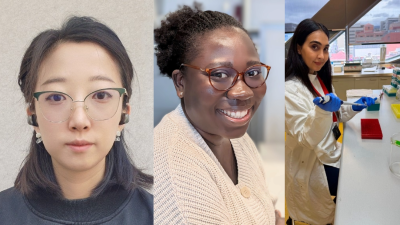


Roberta Mensima Amoah is about to change 150 girls’ lives.
Soon, they’ll meet her at their school in rural Ghana. They’ll do hands-on experiments, ask questions, and see that science isn’t something distant or foreign. It’s theirs.
Across the world in northern China, Liqun Guan is preparing workshops about something most people never think about: how the buildings around us affect our health, our comfort, even our ability to learn. She lived it as a child. Now she’s teaching it.
And in remote regions of Iran, Kimiya Padidar will help equip a high school laboratory and teach students about heart health through biology experiments. Her research shows how pregnancy complications can affect women’s hearts decades later. But she’s not waiting decades to make a difference.
Three researchers. Three continents. One mission: make sure the next generation of scientists includes everyone.
They’re the 2026 fellows of the Inspiring Women in STEMM grant, a University of Tasmania programme that does something unusual. It doesn’t just fund research. It funds the researcher.
“This programme not only supports women in STEMM, it empowers them to inspire and enable the next generation of young learners to discover and pursue STEMM pathways,” says Dr Emily Flies, the programme’s founder and director from the School of Geography, Planning and Spatial Sciences.
To read the full article, click the link below: From Tasmania to the world: Three PhD students on a mission to inspire the next generation